


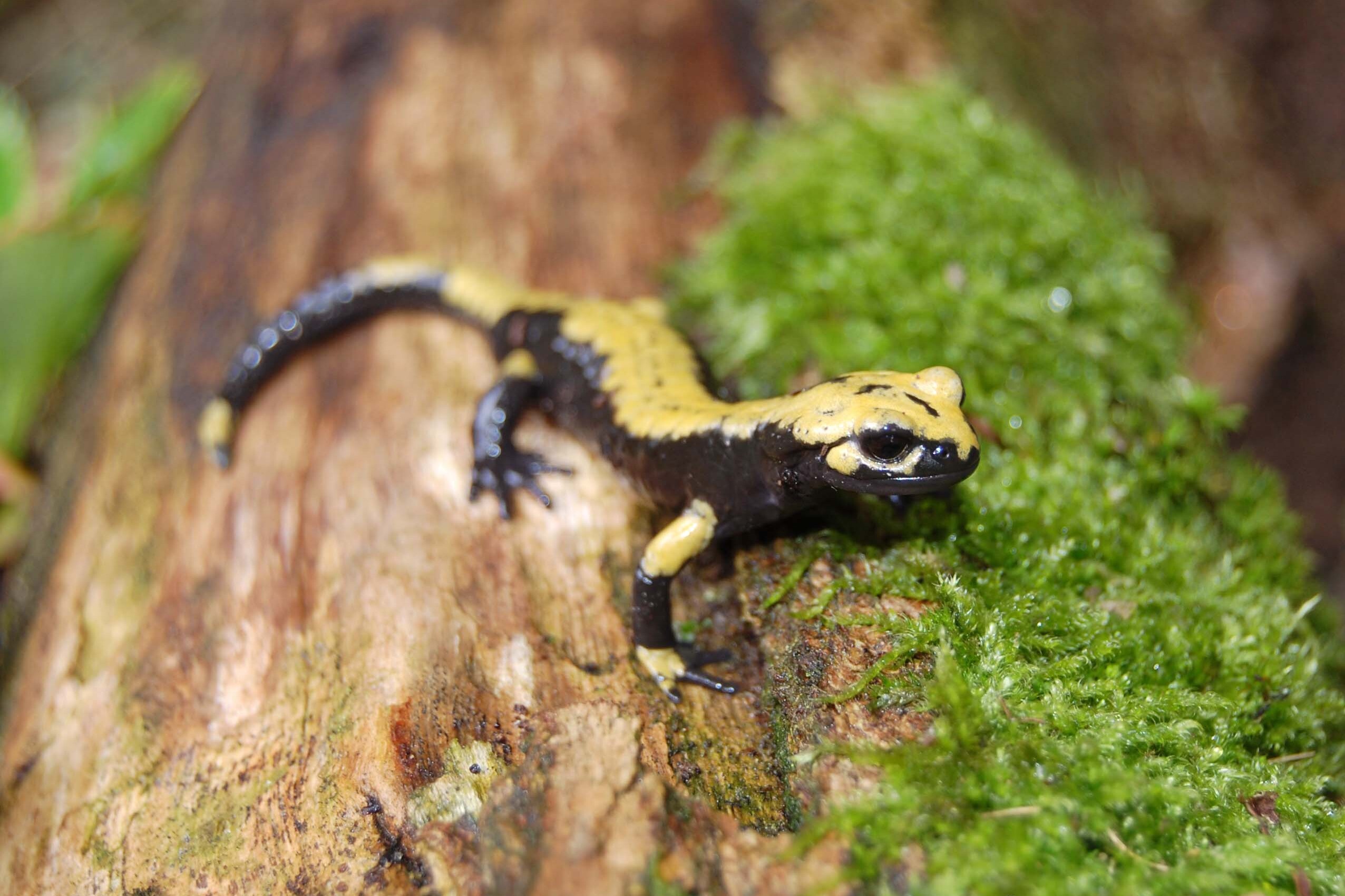
Unlike the evolutionarily younger ‘normal’ Alpine salamander, the Aurora Alpine salamander (Salamandra atra aurorae) has retained remnants of the yellow warning colouring of its ancestors.
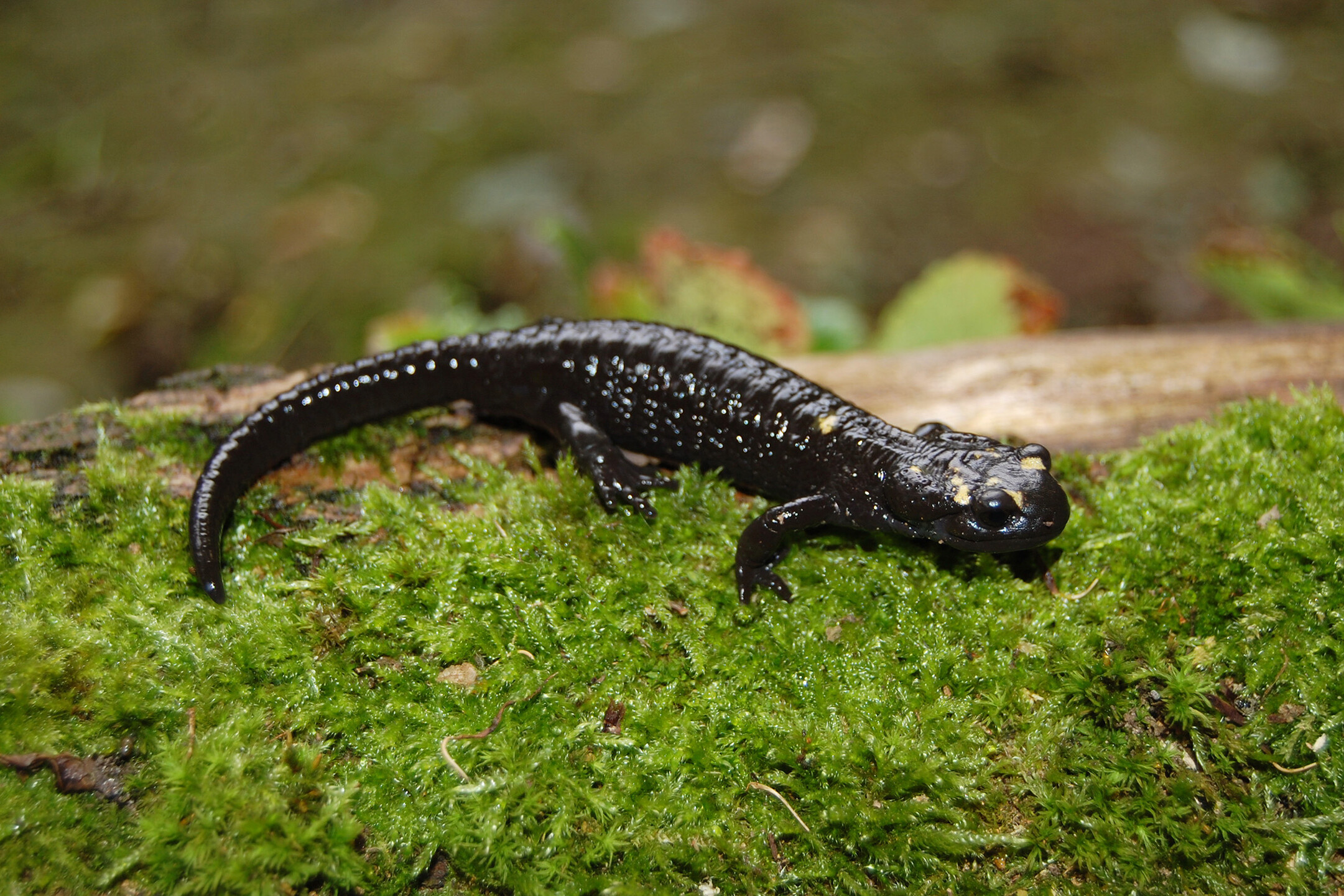
In the case of the even rarer Pasubio Alpine Salamander (Salamandra atra pasubiensis), only a few yellow spots remain.
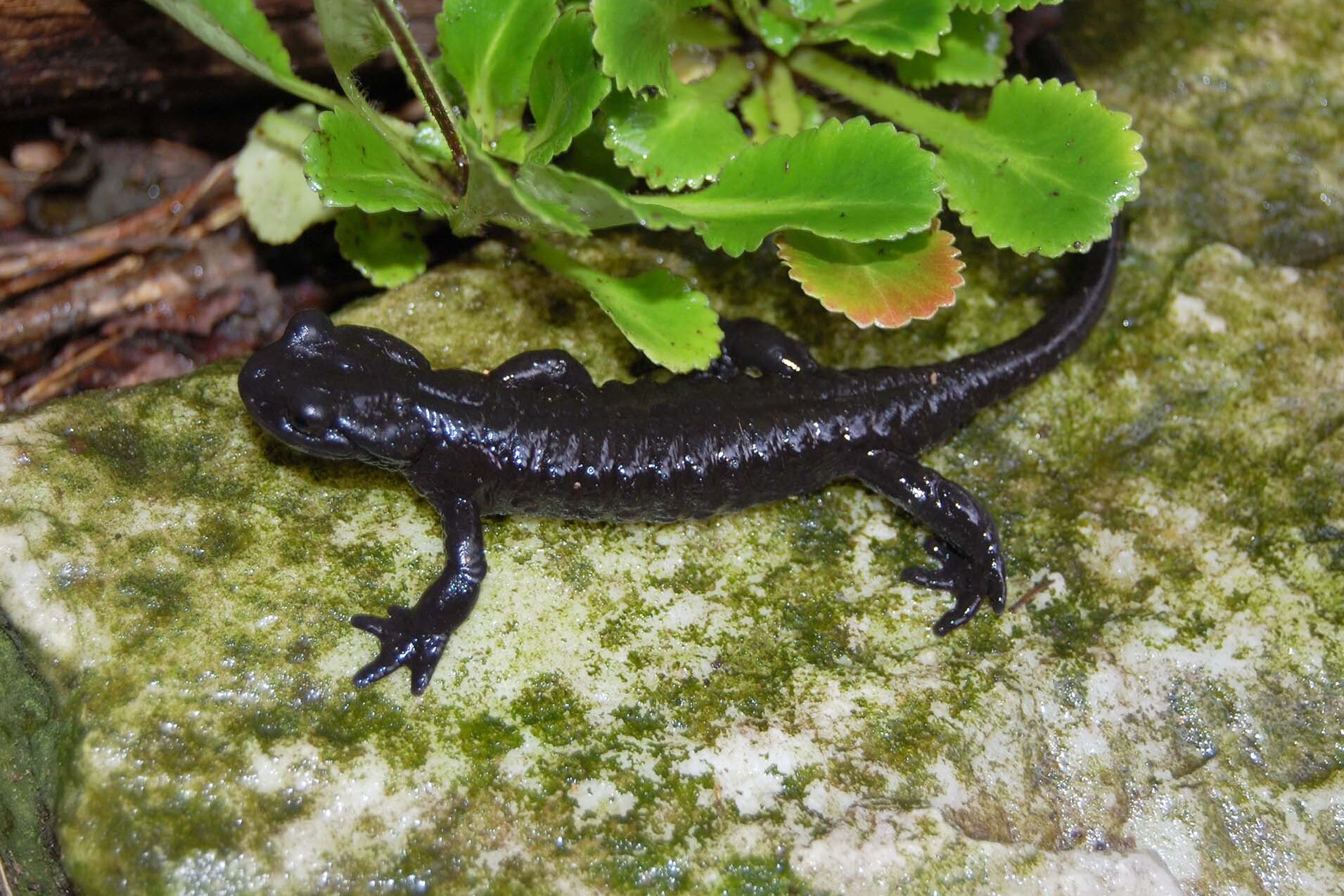
Lanza's Alpine Salamander (Salamandra lanzai) has also fallen victim to poachers.
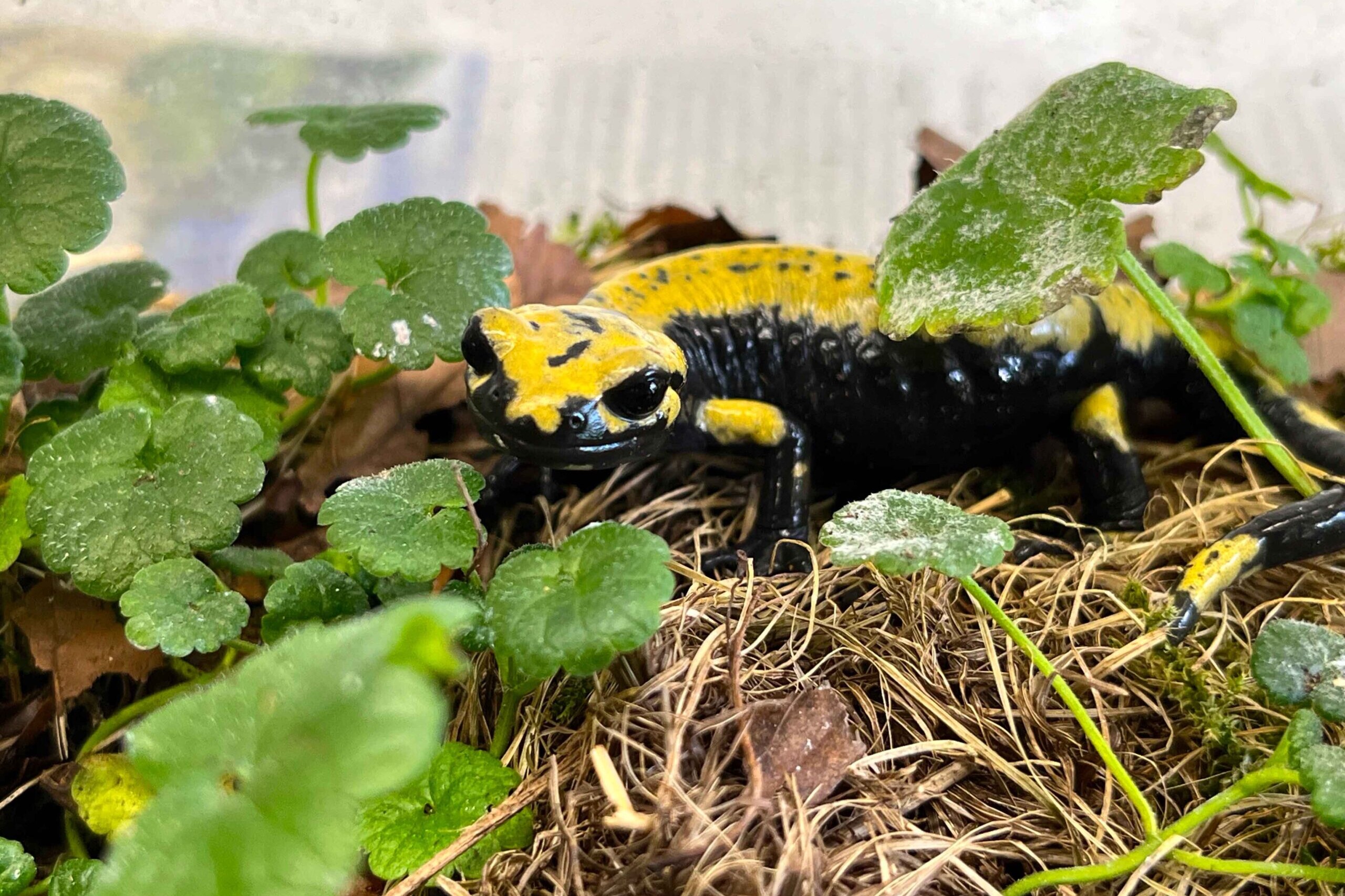
Salamandra atra aurorae
Expert knowledge for species conservation
After the dark basement secret was revealed, Citizen Conservation advisory board member Uwe Seidel, a private terrarium keeper and expert on keeping these amphibians, was asked for advice. He responded immediately and informed Citizen Conservation, the species conservation organisation for conservation breeding and co-founder of Feuersalamander.NET. ‘It was immediately clear to me that these animals are invaluable for species conservation and definitely belong in a protection project,’ says Uwe Seidel.
After consultation with the relevant species conservation authorities, returning them to their original habitat was out of the question for various reasons. At the same time, the situation of these Alpine salamander species is already so precarious that it is urgently necessary to establish a breeding programme in human care in order to preserve them.
Nourish and build up
First of all, however, it was necessary to stabilise the animals, some of which were in very poor health. At the request of the nature conservation authority, Uwe Seidel took on this task. For over half a year, he nursed the animals, which are only 15 cm tall when fully grown, back to health. Meanwhile, CC searched for suitable institutions that were willing and able to provide the necessary facilities and personnel to take on long-term care and conservation breeding. Björn Encke, managing director of Citizen Conservation and Frogs & Friends: ‘The aim was to spread the risk across two locations that were close to Uwe Seidel, because we didn’t want to do without his expertise in salamander care. It was an absolute stroke of luck that
High mountain specialists in the bunker
Alpine Salamanders, which originate from mountainous regions, need cold temperatures. Accordingly, a basement room was prepared at Hanover Zoo – and an entire bunker in Sachsenhagen. Florian Brandes, head of the wildlife and species conservation station, explains, ‘There are a number of old NATO ammunition bunkers on our premises. The temperature in these bunkers remains between 5 and 14 degrees Celsius all year round. These are ideal conditions for Alpine Salamanders, which need a cool environment with a sharp drop in temperature at night, as in the Alps, and also spend a large part of the year in hibernation.’
With financial assistance from Citizen Conservation, a breeding facility was set up in just a few weeks, strictly following Uwe Seidel’s specifications: ‘We know virtually nothing about what Alpine salamanders need to not only stay healthy, but also to mate – so we will probably have to try a few things to achieve success.’
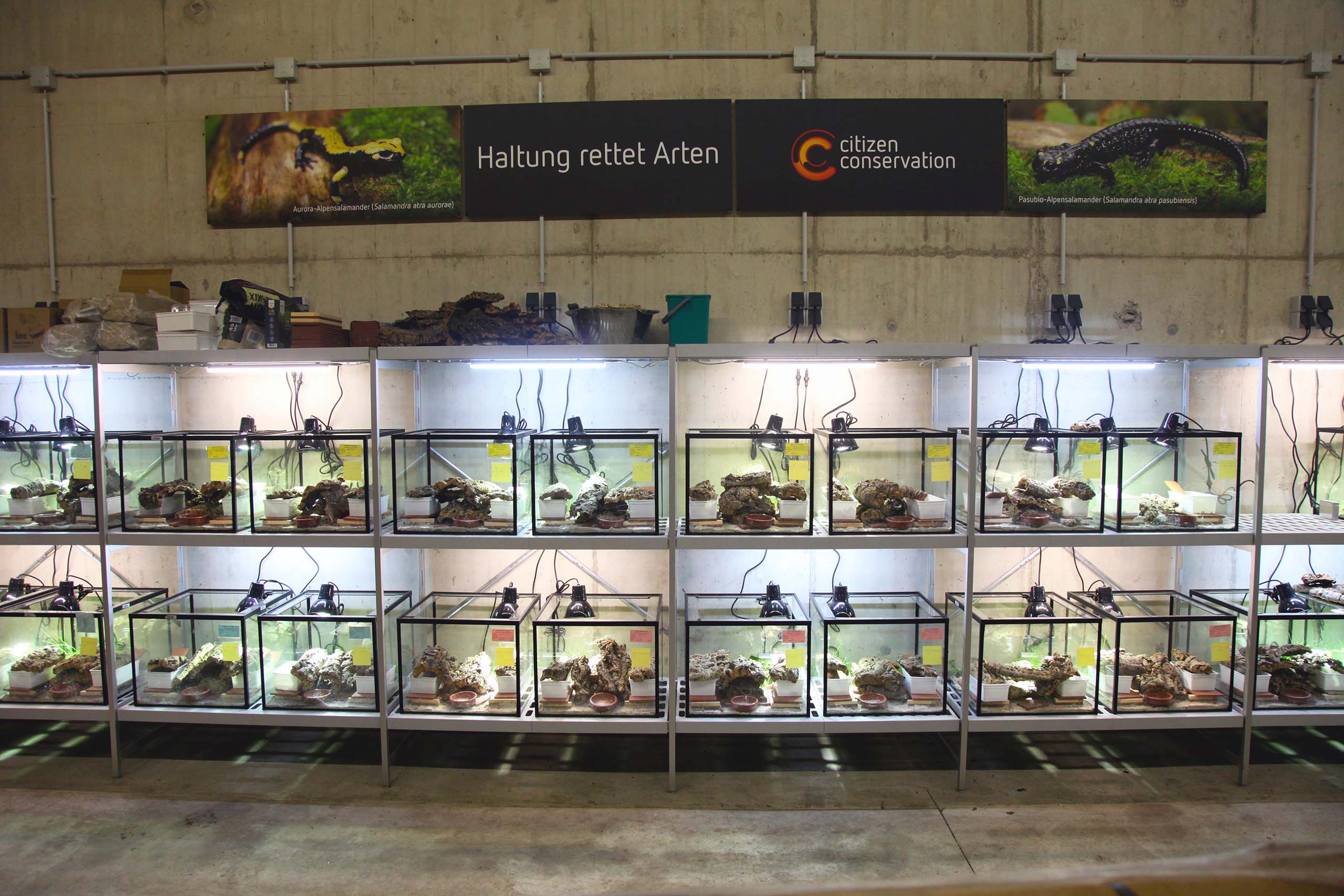
A total of 30 terrariums are located at the wildlife and species conservation station in Sachsenhagen for the preservation of Alpine Salamanders.
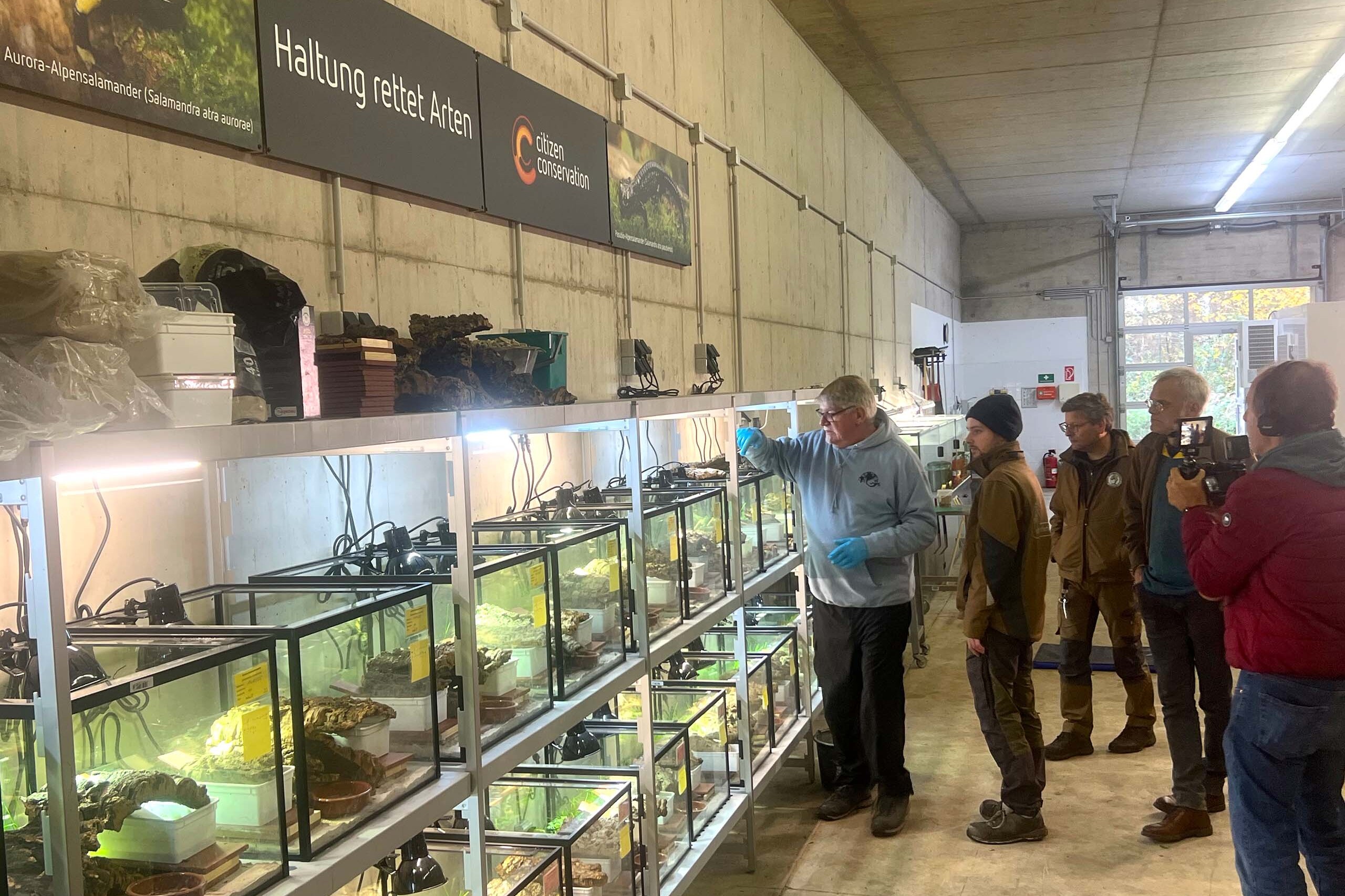
Filming at Sachsenhagen station by Frogs & Friends.
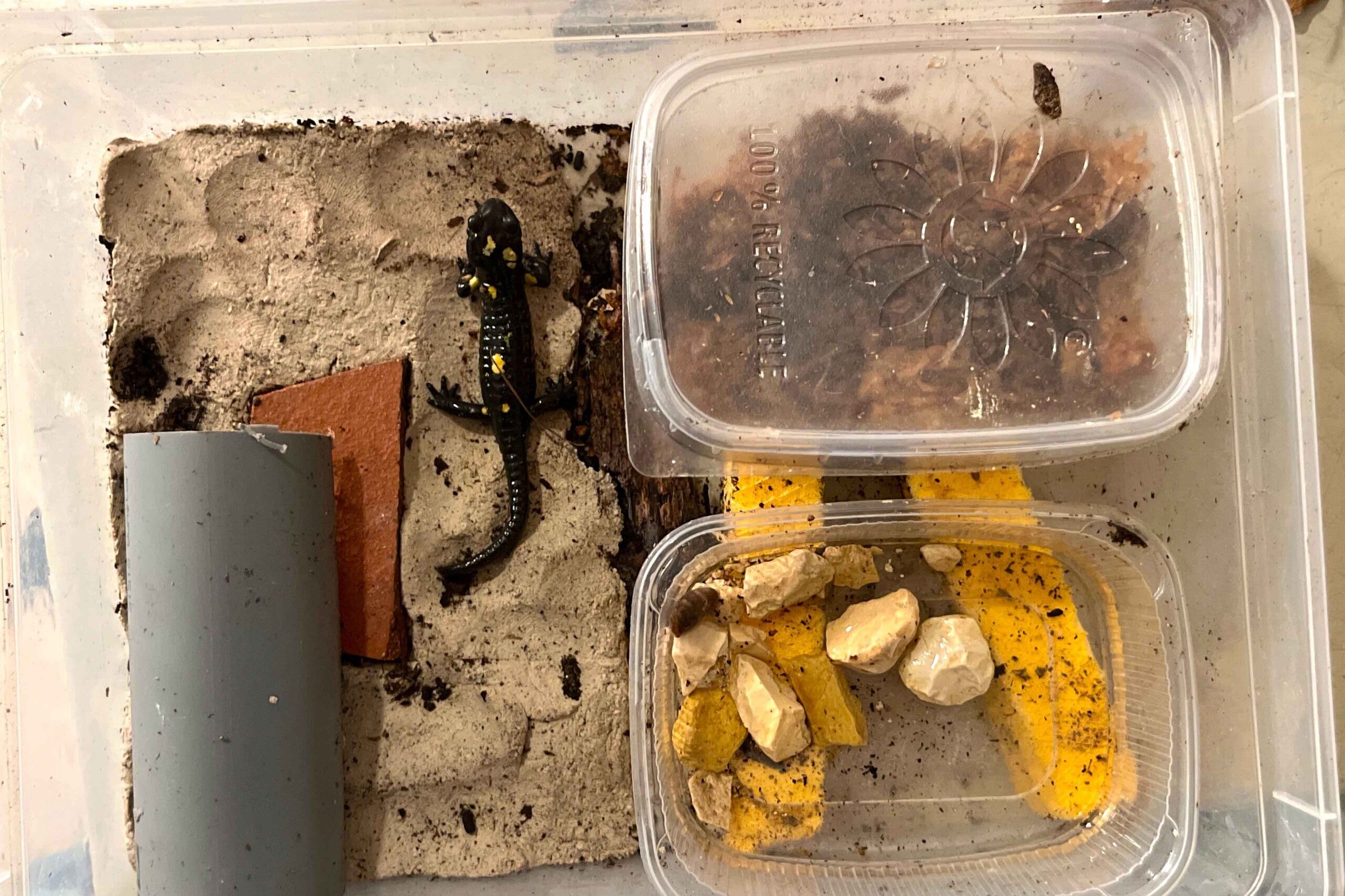
The animals were initially nursed back to health in practical plastic boxes. Here is a Pasubio Alpine Salamander.
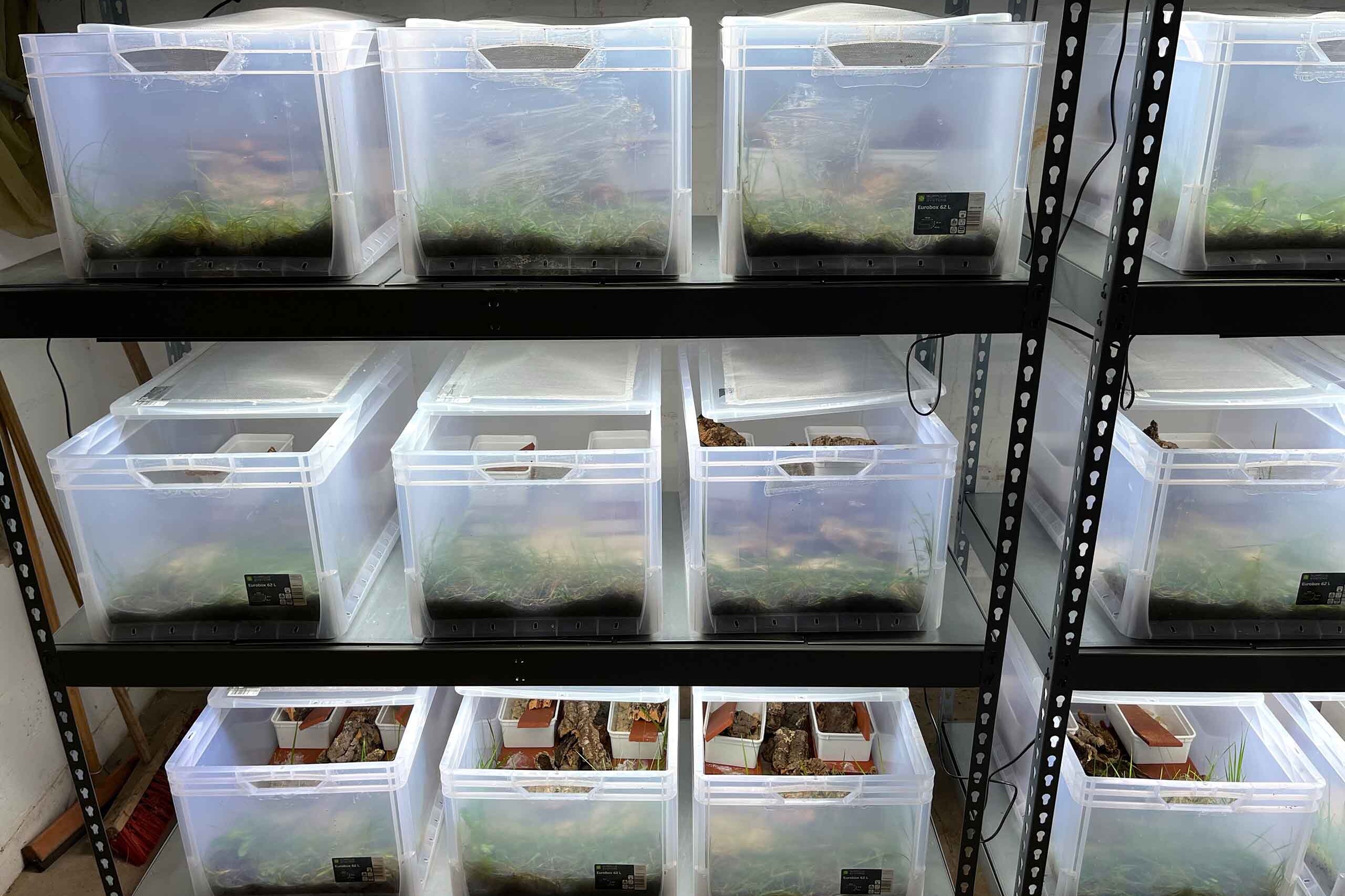
Hannover Adventure Zoo also provides ample space for the conservation of Alpine Salamanders.
Slow reproduction, rapidly growing dangers
Reproduction in Alpine salamanders is extremely lengthy. These amphibians are viviparous. They give birth to only two young every two to four years. The reason for this is the cold climate in their habitat. In the high mountains, temperatures only rise to a level suitable for cold-blooded animals for a few months of the year; the rest of the year they spend in hibernation. This period would not be long enough to lay larvae or even eggs, which then develop in the water. Given these weather conditions, it is therefore better to give birth to only a few young directly in the womb. This highly specialised and time-consuming reproduction makes the Alpine salamander doubly vulnerable. On the one hand, poachers can cause serious damage to the population by collecting even relatively few individuals; on the other hand, this adaptation to the conditions in the high mountains makes them particularly sensitive to climatic fluctuations, such as those expected as a result of climate change. In addition, for several years now, there has been a further threat from the salamander-eating fungus rampant north of the Alps, which is leading to alarming mass deaths in Europe’s Fire Salamander populations. The fungus is also spread via its spores, which can adhere to mud, plants or animals – for example, to the shoes of the very smugglers who illegally hunt amphibians. This particular threat was one of the main reasons why the DGHT designated the Alpine Salamander as the ‘Amphibian of the Year 2026’.
Alpine Salamander Competence Centre at Feuersalamander.NET
This makes research and breeding under controlled conditions all the more important in order to prevent extinction before our very eyes, especially of the two most endangered local endemic species, the Aurora and Pasubio Alpine Salamanders, and the Lanza Alpine Salamander, which is also only found in a small area. This gives us the option of possibly reintroducing animals into suitable habitats at a later date. The Alpine Salamander Competence Centre in Lower Saxony is a first step in this direction.
Feuersalamander.NET, initiated and co-founded by Frogs & Friends 2024, has also been committed from the outset to supporting the protection of the Fire Salamander and the development of ex-situ capacities for its close relative, the Alpine Salamander. The newly established ‘Alpine Salamander Competence Centre’ is an important milestone towards this ambitious goal.
The entire thriller surrounding the poached Alpine Salamanders and the establishment of the competence centre is documented in a film produced by Citizen Conservation, which is now freely available.